Tastenexa
How to meal plan for the week (without giving up by Wednesday)
Most meal plans don't fail because the recipes were bad. They fail because they were built for a version of your week that doesn't exist. Here's the system that survives real life.
If “what's for dinner?” is the hardest question you answer most days, you're not lazy — you're decision-fatigued. You make hundreds of small choices before 6 p.m., and dinner is the one that always gets whatever energy is left. Usually none.
Weekly meal planning fixes that by moving the decision to a moment when you have energy — once, for the whole week, in about five minutes. Here's how to build your first plan the right way.
Why plan a week at a time?
Planning one dinner at a time means deciding every single day, shopping in pieces, and buying ingredients you'll half-use. Planning seven dinners at once means:
- One decision instead of seven. Willpower is a budget — spend it once.
- One grocery trip instead of three panicked ones.
- Ingredients that actually get used, because every recipe was chosen with the others in mind.
Step 1 — Audit your week before you plan it
Open your calendar. Mark the nights you won't cook: the late meeting, dinner with friends, the leftover night after a big Sunday cook. What's left is your real plan — and for most beginners it's three or four nights, not seven.
Planning 7/7 dinners is the single most common way new meal planners flame out. An unused Thursday recipe becomes guilt, guilt becomes abandonment.
Step 2 — Set your guardrails first
Constraints make choosing faster, not slower. Before browsing recipes, decide:
- Diet style: classic, low-carb, vegetarian, keto — whatever genuinely fits how you want to eat.
- Hard exclusions: allergies and dislikes are non-negotiable. Filter them out before you choose, not after.
- Time budget: a realistic weeknight ceiling. For most people it's 30 minutes — if you want the deeper reasoning, we wrote a whole post about the 30-minute dinner rule.
Step 3 — Pick recipes that share ingredients
This is the step most guides skip, and it's where the real money is. When your recipes overlap, your grocery list gets shorter and your fridge stops becoming a graveyard.
Example: if Monday's grain bowl, Wednesday's curry and Friday's salad all use spinach, you buy one large bag — and you finish it. Three unrelated recipes? You buy three half-used bags and compost two of them.
When you plan, look for recipes that share a protein, a green, or a base (rice, grains, tortillas). Variety comes from sauces and seasonings, not from seven completely different shopping lists.
Step 4 — Build the grocery list while you choose
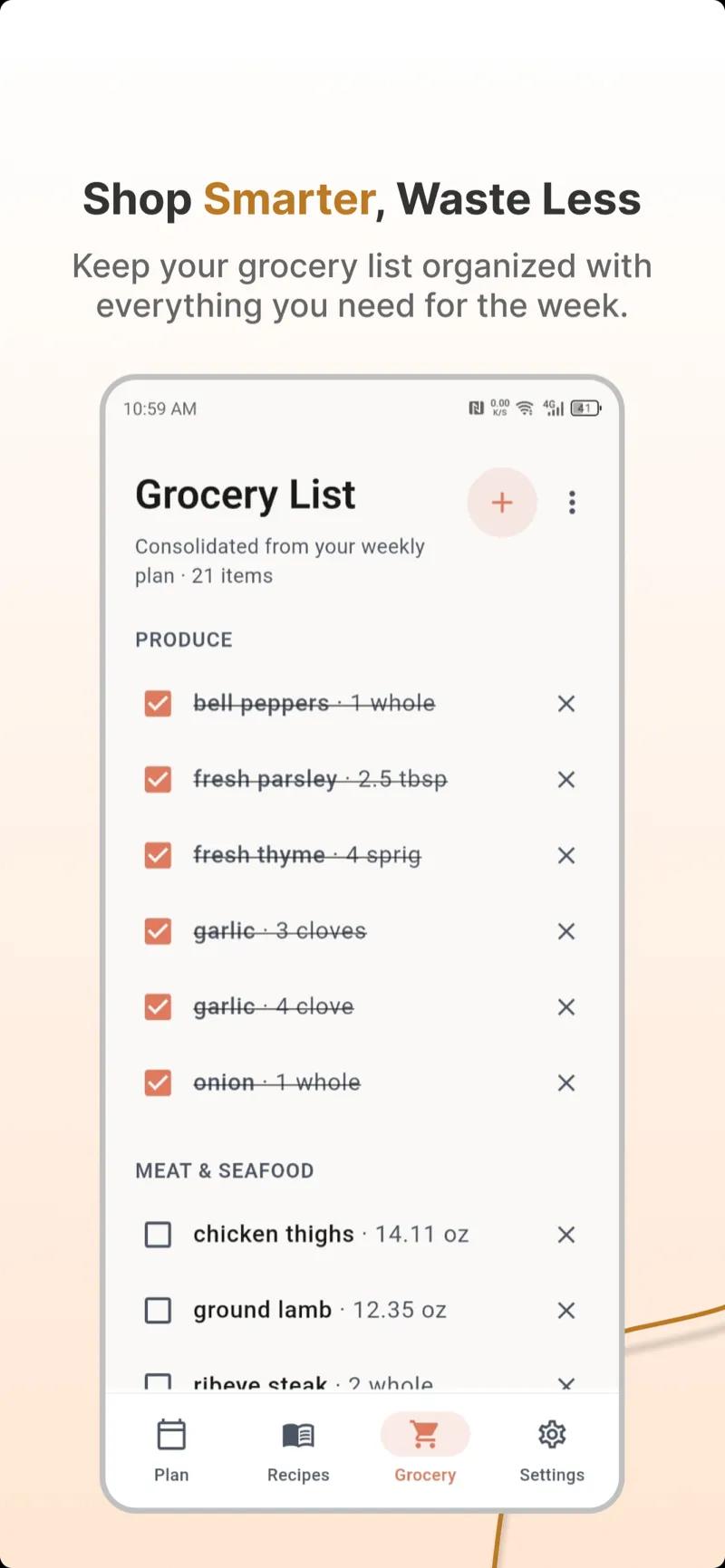
Don't pick recipes first and “do the list later” — later never comes. Every recipe you approve should go straight onto one consolidated list, with duplicates merged and everything grouped by store section. We break down why this saves real money in how to build a grocery list that saves money.
Step 5 — Build in a swap valve
A plan you can't change is a plan you'll quit. Life moves — a work dinner appears, a lunch becomes leftovers. Decide now that any recipe can be swapped for another that fits the same guardrails, and the plan bends instead of breaks.
Once a week, glance at the plan: move anything you didn't cook, thaw what needs thawing, wash the sturdy produce. Fifteen minutes on Sunday buys you five stress-free evenings.
Beginner mistakes to skip
- Planning every single night. Leave one night explicitly for leftovers or takeout. It's part of the plan, not a failure of it.
- Choosing aspirational recipes. Weeknight-you is tired. Plan for weeknight-you.
- Shopping without the list. The list is the plan's delivery mechanism — without it you're just browsing with extra steps.
- Starting from a blank page every week. Keep what worked; swap what didn't. The second week should take half the time of the first.
The five-minute version
- Check the calendar → find your 3–5 real cooking nights.
- Apply guardrails: diet style, allergies, dislikes, 30-minute cap.
- Pick recipes that share ingredients.
- Consolidate into one grocery list, merged and organized by section.
- Swap anything, any time — the plan is a default, not a cage.
That's it. No binder, no color-coded containers, no Sunday spent cooking six quiches. A plan is just a handful of decisions made in advance — made once, calmly, instead of nightly, hungry.